The History of Love


[May 2011]

**********
The History of Love, Nicole Krauss
number of voters: 3
percentage of voters who finished the book: 100
highest rating: 8
lowest rating: 6
average rating: 7
average star rating: 3.3 stars

note: One reader chose not to finish the book because she very much disliked it. She did not give it a rating.

*****

THINGS WE LEARNED FROM ‘THE HISTORY OF LOVE’
  1. There are layers to this book that we didn’t even realize existed until after we’d put it down.
  2. It is possible to write a piece of modern fiction that doesn’t fit the modern mold of the modern fiction genre.
  3. It’s okay to not always know what is happening as it is happening.
  4. Sometimes it’s a good thing to leave giant spaces on a page and make a reader try to turn the pages as fast as she can read them.
  5. If you’re going to write a book in which the title of the book refers to a book within that book, make sure the book within the book is better than the book within this book.


There is probably more. And yet. How can we convey the nuances of the story? How can we express the dichotomy of simplicity and complexity that fills its pages?
See for yourself. What will you learn from “The History of Love”?

Little Bee

[April 2011]

***********
Little Bee
Chris Cleave

number of voters: 8
percentage of voters who finished the book: 100
highest rating: 7.5
lowest rating: 3.5
average rating: 5.0625
average star rating: 2.5 stars
special prize: most brilliant marketing concept ever

*****
We want to tell you what happens in this book.

It is a truly mediocre story and we want to spoil it.

However, you need to know enough not to buy it, so we will just say this:

[SPOILER ALERT!!!]

This is the story of two women (an African girl who calls herself Little Bee and a spoiled, unlikable British woman named Sarah). Their lives collide one fateful day (on a Nigerian beach, where Little Bee is fleeing for her life and Sarah is being a stubborn, stupid British tourist), and one of them has to make a terrible choice (cut off your finger and possibly save a girl’s life or return to England with all ten digits in tact). Two years later, they meet again (when Little Bee shows up on Sarah’s doorstep on the day of Sarah’s husband’s funeral)—the story starts there (well, not really… it actually starts somewhere else, but that isn’t as interesting for the book’s front flap)…

Once you have read it, you’ll want to tell your friends about it (because you’ll want them to know that it’s best not to judge a book by its totally awesome cover). When you do, please tell them what happens (because you’ll want to warn them to not believe the hype). The magic is more in how the story unfolds than that there is some giant plot twist.

Let us say just one more thing: Little Bee does indeed have something to offer. It is far from amazing and completely over-hyped, which can lead to an overwhelming sense of disappointment; however, there are moments of dazzling color, and the story raises some intriguing topics to discuss. The thing of it is, we feel you should decide to read this book not because of the hype or the great mysterious plot twist pushed by its marketing campaign, but because it sounds interesting to you.

***********

The Hundred Secret Senses, Amy Tan

[March 2011] 

***********
The Hundred Secret Senses, Amy Tan
number of voters: 5
percentage of voters who finished the book: 100
highest rating: 10
lowest rating: 6.5
average rating: 7.68
average star rating: 3.3 stars

alternate title: The 100 Secret Plots

*****

My book group friend believes she has yen eyes. She longs for those plots that have trailed off or died as though they were still sitting in her kitchen on Hampshire Street in Eugene.
Actually, I believe her. I’ve seen some of those plots myself, although I won’t admit it—to her or to anyone. Maybe people will think I am as crazy as my book group friend and lock my future book choices up in that place where book group recommendations go to die.
But I’m getting ahead of myself.
You see it all started when our book group read The Hundred Secret Senses, by Amy Tan. Some of us loved it, while others struggled to get through. Just to set the record straight, there were two that night who admitted they couldn’t finish it—and that isn’t counting the others who didn’t even bother to attend (not that I blame them, but this is just a factual account, you understand).
But I digress.
The important thing is that my friend, she loved this book. Sure, many of us were able to follow the story, for the most part. Some of us even enjoyed it. But my friend, she gets it. She sees the story like an elaborate quilt, the various plot threads all woven together. While we stumble along trying to find our needle and thread, she is happily piecing together the grand work of art—the story, the language, the characters, the thoughts, the other-worldliness of it all.
Maybe you too have yen eyes—that longing for plots that require patience and suspension of disbelief and a sort of hold-on-and-don’t-let-go ride. Maybe you will be able to follow the story, for the most part. Maybe you will even like it. Or maybe, if you are like my book group friend, you will get it.

In any case, it is likely you will never read another book quite like this one. Whether that is a good thing or a bad thing is all in how you see it.

**********************

Same Kind of Different as Me


[February 2011]


Same Kind of Different as Me, Ron Hall & Denver Moore
number of voters: 8
percentage of voters who finished the book: 88
highest rating: 8.5
lowest rating: 7
average rating: 7.9375
average star rating: 3.875 stars

*****

This is probably my twentieth attempt to begin this recap.
A sample of what’s already been tried (and deleted):

-God can use anyone.
-Do you consider yourself courageous?
-Let me tell you my version of events… (from Deb’s perspective)
-Did you wake up today? Be glad!
-Even if you ain’t a big reader type, this here is one good story.
-An art dealer, his chipper wife, and a homeless guy walk into a bar…

As you can see I’ve not made a lot of progress.

It’s ironic that a book that our group rated so highly should leave me so stymied to recap. Then again, maybe it’s because this book is so unusual.

Same Kind of Different as Me is a real story about real people and their very real journey from ignorance and indifference to trusting both in people and in God. And yet somehow that summary doesn’t even begin to convey the depths of this book. I could relay the plot, but only in reading it for yourself will the story come to life. It is more than a story; it is a journey.

So, I guess in conclusion I will say: God CAN use anyone, and even if you ain’t a big reader, this here is one good story.

Half the Sky

[January 2011]

Half the Sky, Nicholas D. Kristof, Sheryl WuDunn
number of readers: 7
ratings: unrated, recommended

*****

“Women hold up half the sky.” —Mao Tse-Tung

And the sky is falling.

Today, right now, this very moment… women and girls are being exploited, oppressed, and abused.

Today, right now, this very moment… you can do something about it.

Will you?

Can you seize this opportunity to decide that you will not look the other way? That you will not shrug? That you will not think the problem is so big that one person cannot make a difference?

Are you wondering what you could possibly do to change the world? Here are a few suggestions from someone who feels exactly like you do:

• Read the book Half the Sky.

There are millions of causes out there. And there are millions of ways to help. The first step is choosing not to look away.

The 19th Wife

[December 2010]


The 19th Wife, David Ebershoff
number of voters: 8
percentage of voters who finished the book: 88
highest rating: 8.25
lowest rating: 4
average rating: 6.5
average star rating: 2.9 stars

*****
We must convene in secret. None would understand our fascination with the written word. By all accounts, we are mere housewives who should be occupied with our matrimonial and domestic duties and nothing more. Thus, when I confide in you, dear reader, that we ‘simple’ housewives collude in concealed corners in the dark of night, I entrust you with our deepest secret. We discuss the merits and shortcomings of the latest publications. Often we are required to attain these titles in back alleys, in disguise and under constant threat of discovery. Our latest procurement is a jewel, indeed, worth every danger. It concerns one of our own, a sister wife who defied her husband, her prophet, her faith, and her God. Oh, Ann Eliza! The ‘nineteenth wife’ of our dear Brigham has woven quite a tale. There is truth in these pages, yet no one save God himself shall ever know how much. Some of the sister wives believe every word, perhaps tempted by the perceived freedoms beyond their grasp. Others shun every word as fantasy, apart from the few indisputable facts. A small number believe that the book--no matter how factual or preposterous--will be our very undoing. I silently wonder if someday another writer will not take pen and paper in hand only to defame the history of our faith with tales of modern salacity. Dear reader! Should you endeavor to master this effort by Miss Young, take care! It may ask questions you are not suited to answer. It may answer questions you were not prepared to ask. If the written word can incite such quarrels amidst habitually loving sister wives, if one story can arouse such doubt and suspicion and protectiveness amongst our own, what, pray-tell, will the effect be on the unbelieving soul?

Let the Great World Spin

[November 2010]


Let the Great World Spin, Colum McCann
number of voters: 8
percentage of voters who finished the book: 100
highest rating: 8.75
lowest rating: 3.5
average rating: 5.84
average star rating: 2.5 stars

*****

A man suspends a tightrope between the World Trade Center towers. For 45 breathtaking, spectacular minutes he walks, runs, even dances on a ¾-inch wire 110 stories up in the air. Below him, a city inhales, exhales.

Colum McCann captures it. Like a snapshot of one ordinary yet historic day, Let the Great World Spin suspends itself across the wire of your imagination and burns the imprint into your mind.

It’s New York, 1974, and you are there! You know these people, these average yet inimitable brothers, sisters, mothers, daughters, wives, husbands. They are so vividly drawn you can almost touch them.

A fascinating concept with an attention grabbing opening plus a tangle of unforgettable characters written exquisitely by an informed author should equal a satisfied reader. But that’s not to see we enjoyed it. Unforgettable does not mean likable, and these characters are so raw that McCann risks losing his audience to indifference. These are not fairytale protagonists, and it’s sometimes difficult to care where the story might take them.

Yet Let the Great World Spin is not so much a story as it is an experience. You could know every plot point in this book and it would not spoil the reading of it. McCann has such a commanding grasp on the use of language to convey tangible, vivacious, squalid life that you are drawn into his world to the very end.

Let the Great World Spin is a work of art. You might not like it, you might not hang it above the mantle, but if you take the time you might appreciate it as a masterpiece.

The Art of Racing in the Rain

[October 2010]


**********
The Art of Racing in the Rain 
Garth Stein

number of voters: 6
percentage of voters who finished the book: 100
highest rating: 8.5
lowest rating: 4
average rating: 6.95
average star rating: 3.25 stars

*****

I don’t read much... maybe because I am a dog. The letters (the ones I know) get all mixed up and besides, I prefer TV (mostly car racing).

But you can understand if I get a little excited about The Art of Racing in the Rain. Now, this is my kind of book. It’s about a dog (like me) who likes TV (like me), and he’s a really great dog (like the kind of dog I try to be) — the kind of dog anybody would want, even if they weren’t a dog person (which is something I will just never understand).

But about this story... it’s about a great dog with a great person (you know he’s great because the storyteller tells you he is) who has lots of bad stuff happen to him (some of it I understand and some I don’t and some of it is just silly) but the dog is always there for him (like I would be if I were that great of a dog).

And this dog is really smart! I don’t just mean smart like letter smart (I don’t think he can read either) but I mean lifesmart. He knows more about stuff than even his person does (which maybe isn’t saying much... I don’t really know people too well). And when this dog talks about opposable thumbs I just go nuts! (I’m still trying to figure out what “opposable thumbs” is, but this dog talks like it’s the best thing ever.)

Anyway, I’m sure every dog will love this book. (You can have your person read it to you). I suppose there are somepeople who might not appreciate it (“predictable,” “flimsy plot,” “flat characters,” blah blah blah), but any dog in his right mind will laugh, cry, and bark at The Art of Racing in the Rain.

Sarah's Key

[September 2010]


**********
Sarah’s Key 
Tatiana de Rosnay

number of voters: 10
percentage of voters who finished the book: 100
highest rating: 7
lowest rating: 5
average rating: 6.4
average star rating: 2.75 stars

**********
Imagine you’ve received a poorly wrapped gift. You are pleased, of course; everyone appreciates a present. But you notice that it isn’t exactly a pretty gift. The ribbon hangs loosely. The wrapping is messy. The paper is so thin you can see through it to the recycled cereal box underneath. You don’t mean to seem ungrateful, but it is obvious that whoever wrapped this gift either did not know what they were doing or did not take care to wrap it properly.

So it is with Sarah’s Key, a historical novel based on a little known event—the Vel’ d’Hiv Roundup—that occurred in France during the Vichy government of World War II. The novel follows one fictional young girl through the historically true story, in which thirteen thousand French citizens of Jewish descent were forced out of their homes by the French police, held at the Vélodrome d'Hiver (an indoor bicycle racetrack) and Drancy internment camp, then eventually transported to Auschwitz, where they were killed.

Sarah’s story is compelling and heartbreaking, and in telling it, author Tatiana de Rosnay successfully sheds light on what has heretofore been a hushed aspect of French history and the French government’s complicity in it.

Where de Rosnay fails is in the modern story interwoven with Sarah’s. Sarah’s story is uncovered by Julia, a journalist who is assigned a story about the 60th anniversary of the Vel’ d’Hiv Roundup. Unlike Sarah, Julia is mostly uninteresting and slightly annoying. The novel bogs down when it follows Julia’s story; it’s weakest moments come when Julia is at center stage, leaving the reader hoping Sarah’s voice will return soon.

And so Sarah’s Key is a gift of historical fiction in a less than satisfactory wrapping. The modern setting is an unattractive ribbon. The writing is uninspiring. The plot is so thin in places that you can see through to the recycled clichés underneath. It seems that the writer either didn't know what she was doing or did not take care to write it properly.

Yet a gift poorly wrapped is still a gift. The book’s redeeming quality is it’s history, and for that reason alone, it is a gift we recommend accepting.

Water For Elephants

[July 2010]


**********
Water for Elephants 
Sarah Gruen

number of voters: 8
percentage of voters who finished the book: 100
highest rating: 8.75
lowest rating: 7
average rating: 8.1

experimental star rating system, average star rating: 4.3 stars

*****

She was a circus performer. He was a veterinarian student. Water for Elephants is the story of their complicated relationship.

But it isn’t entirely what you’d expect: Her names is Rosie, and she is an elephant.
The story begins with a catastrophe at Benzini Brothers Most Spectacular Show on Earth, a circus that is struggling to make ends meet during the Great Depression. But before the reader can even begin to grasp what is happening, we are hurtled forward to a near-present day nursing home, where the story’s protagonist withers.

Author Sara Gruen’s masterful sense of character propels the rest of the tale. We are taken back and forth between two worlds where we can alternately marvel at the wonders of a young man’s life on a circus train in early 20th century America and then contemplate the complexities and challenges of his growing old at the start of the 21st century.

Ultimately, Water for Elephants is a story about love and hate, about young and old, about wisdom and naivety. It stretches the boundary of what is normal, what is acceptable, and what can be tolerated. It details the battles and bonds between people and animals in sometimes brutal yet ultimately heartwarming fashion. It is well researched, well written, and, to put it simply, a spectacular read.

Aside from a slight hesitation due to some occasional yet vivid sexual content, Water for Elephants is highly recommended.

The Mysterious Benedict Society


[June 2010]


**********
The Mysterious Benedict Society
Trenton Lee Stewart
number of voters: 6
percentage of voters who finished the book: 100
highest rating: 10
lowest rating: 6.25
average rating: 7.58

experimental star rating system, average star rating: 3.8 stars


**********

WANTED: Bright readers for a delightful read. Must love a wee bit of wordplay, a smidge of sci-fi, a peppering of puzzles, and a pack of pint-sized protagonists. Bring only a suspension of disbelief and a playful spirit.

—————

Sometime in the near future, the world’s inhabitants will be on the brink of losing their minds to the control of an evil mastermind, Mr. Ledroptha Curtain. But, thankfully, a team of crack pre-teens is on the case.

Reynie, Sticky, Kate, and Constance comprise the Mysterious Benedict Society, so named for their narcoleptic leader, Mr. Benedict. Their adventures begin with a cryptic ad in the newspaper and end with a, well... we don’t want to give too much away, now do we?

Let’s just say that it involves a slew of tests, a secluded island school, a creepy machine, and a whole lot of booby traps. Oh, and a surprising little twist.

It won’t be the most riveting book you’ve read, nor the most believable, enlightening, or intellectual. But it is a fun, mostly easy read that you can enjoy with your kids (or your classroom).

Just remember: You must follow all the instructions in the ad or you will be disqualified!

Thr3e

[May 2010]

 **********
Thr3e
Ted Dekker
number of voters: 8
percentage of voters who finished the book: 87.5
highest rating: 6.25
lowest rating: 3.75
average rating: 5.25

percentage of readers with either seminary or psychology degrees: 0

*****

It was one of those simple-to-read, easy-to-follow kind of plots, but it didn’t give away all of its secrets until the very end. And the pages turned faster than a car in a high-speed chase.

In the novel Thr3e, author Ted Dekker gives us Kevin Parsons, a seminary student with a mysterious past who is suddenly thrust into a high-stakes game of riddle-me-this with an anonymous psychopath.

It’s a fine way to pass a few hours, discovering what happens to Kevin Parsons. The riddles are moderately interesting; the suspense is page-turn-worthy; the creepy factor is, well, creepy enough. And bonus points to Dekker for keeping his plot twist unsuspected by almost an entire book group.

But beyond the attention-grabbing plot, it’s all just a little yawn-inducing. The writing is run of the mill; the characters are mostly roughly drawn outlines; the dialogue alternates between silly and tedious.

The end result is an interesting idea wrapped in an uninteresting package. Which leads us to perhaps the biggest riddle of all:

What’s hard to put down but easy to forget?

The Book Thief

[April 2010]

**********
The Book Thief
Markus Zusak

number of voters: 5
percentage of voters who finished the book: 5
highest rating: 9
lowest rating: 8
average rating: 8.4

percentage of readers who are more grateful for books after reading this book: 100

* * * TWO QUESTIONS: * * *
1. Do you like historical fiction?
2. Are you open-minded?

Yes and yes? That’s a good start.

* * * A DEFINITION * * *
open-minded
adjective
willing to consider new ideas; unprejudiced


Still with me? Good. Now you are ready to meet the book thief and the one who tells her story. But I won'’t be the one to introduce you. I will let the author himself do that. Because, no matter how I phrase it, there is no way to summarize this book in a few sentences without making the book sound cliché... and it is anything but that.

* * * ANOTHER DEFINITION * * *
What this book is not:
cliché
noun
a very predictable or unoriginal thing


Let’s review what we know so far:

* * * THE BOOK THIEF by MARKUS ZUSAK... * * *
...a kind of historical fiction
...requires an open mind
...completely unpredictable and original

Is this enough for you? Can you commit yourself to reading a book without knowing anything about time period, setting, or plot? No? Then just for you:

* * * THREE THINGS YOU MIGHT WANT TO KNOW * * *
1. time period: World War II
2. setting: Germany
3. plot: not what you’d expect from 1 and 2

There. I’ve said enough.
More than enough.
Go meet the book thief, then come back and we’ll talk.

The Glass Castle

[March 2010]

**********
The Glass Castle
Jeanette Walls

number of voters: 9
percentage of voters who finished the book: 100
highest rating: 9.7
lowest rating: 7.5
average rating: 8.189

percentage of readers who used the words “really liked” or “loved” to describe what they thought of this book: 100

*****

Imagine a car wreck on the freeway. Traffic slows, heads turn, eyes gape. And then on we drive. A moment later, it is forgotten.

Here, in The Glass Castle, a little girl reveals all the gory details behind that wreck. Her innocent voice is the one we hear as she describes the way people in her family collide with one another, a mass of crumpled hopes, fears, and expectations. The collision is her childhood; the mangled ruins, her life; the burning wreckage, her. This is the story of Jeannette Walls.

The story goes something like this: Four kids grow up in poverty and neglect with their brilliant, alcoholic father who loves them emphatically and their artistic, emotionally unstable mother who believes what does not kill them will make them stronger. The makings of a car wreck, indeed.

And yet—miraculously perhaps—they all walk away intact. There are scars, of course. There always are. But you would never know from looking at them that they had lived through such adversity. You wonder how anyone could possibly even survive it.

In this way, The Glass Castle is inspiring where it could have been depressing, full of promise when it could have been only tragic. And now we know what it is not just to gawk in passing, but to look—really, closely look—at disaster. There are atrocities, but there is also resiliency.

Read this book. It is a difficult tale, beautifully told; surprisingly humorous; moving and unforgettable.

Wicked: The Life and Times of the Wicked Witch of the West

[February 2010]

**********
Wicked: The Life and Times of the Wicked Witch of the West
Gregory Maguire

number of voters: 5
percentage of voters who finished the book: 80
highest rating: 4.75
lowest rating: 3
average rating: 4.05

percentage of readers who, with knowledge of both, preferred the musical to the book: 100

*****

And so I find myself once again in the unenviable position of writing a recap of a discussion about a book that I did not read—a book that, after a handful of excruciating pages, I could not stand even an attempt at reading. I recognized these storybook names—the munchkins, the wicked witch of the west—and these fantastical faces—squat and plump, a ripe shade of green—but everything else was foreign and, to be honest, a bit nauseating.

And so I left it to others, far more brave than I, to tackle this doorstop of a novel. Maybe they would see something in it that I could not or did not want to see.

Not so much.

To summarize the words of those brave readers: The author was trying too hard and trying to fit too much in. There was no flow to the story, which jumped around way too much. It was too political. There were no redeeming qualities in the characters, who were thus simply unlikable. There was too much happening and not enough depth. The author shot for “epic” and didn’t pull it off.

But maybe there was something there that none of us could quite see. It was, after all, a brilliant idea, completely original (that is, if you discount the fact that the novel is based on someone else’s work), and asked some interesting questions (for example, how do our experiences shape us?). It’s up to the individual reader to decide whether this smattering of qualities is worth wading through such prolific misery.

To make a long story short, which perhaps the author himself should have considered, we did not really like it, we would not recommend it, and we wished we’d spent the time going to the musical instead.

A Tree Grows in Brooklyn

[January 2010]

**********
A Tree Grows in Brooklyn
Betty Smith

number of voters: 6
percentage of voters who finished the book: 83
highest rating: 9.5
lowest rating: 8.5
average rating: 9.17 (!)

percentage of readers who have lived in Williamsburg: 0

*****

The women of Williamsburg gathered to reminisce, and the stories flowed like wine. It was as though weeks had passed instead of years, though nearly a century had gone by. Brooklyn will never be the same as we remember it then... a generation frozen in our minds.

Oh, except that we weren’t there.

You can forgive us, can’t you, for forgetting that Francie’s story is not our very own? If you’ve read Betty Smith’s pseudo-autobiography, then you know...

These people stroll through the streets of Brooklyn and onto the pages and into our consciousness. Remember how Papa understood Francie’s need to attend the finer school and took matters into his own hands? Remember the way Mama made Francie and Neeley read from Shakespeare and the Bible every night? Remember Aunt Sissy? Remember the tin can?

Like visiting an old friend, we will return to A Tree Grows in Brooklyn again and again. Our feet walked the dirty ground, but our eyes saw the sky beyond. And our hearts were full of hope. 

The Elegance of the Hedgehog

[December 2009]

**********
The Elegance of the Hedgehog
Muriel Burbery

number of voters: 6
percentage of voters who finished the book: 83
highest rating: 10
lowest rating: 6
average rating: 7.83

percentage of readers who hold a degree in philosophy: 0

*****
Marx has the ability to completely change the way one views the world. One need not agree with him to necessitate said change; the evolution of thought occurs with or without concurrence.

So it may be with Muriel Barbery and her eclectic collage of aristocratic and working class figures coexisting in a Parisian apartment.

The title, The Elegance of the Hedgehog, refers, in no subtle way, to the hidden intellectualism (elegance) of the building’s underclass concierge (hedgehog), Renee. Her secret is uncovered by the adolescent, quasi-suicidal Paloma, a paltry girl who is wealthy yet suffers from a dearth of human affection.

I would be negligent if I did not mention that the author is a professor of philosophy. Her novel is dense, overloaded with metaphysical contemplation. The plot develops at an almost sedative pace, but when it—finally, fantastically—engages it is in a headlong rush that leaves the reader almost dizzy with, in turns, exultation, anguish, and simple, quiet beauty.

Concerning the denouement—and here I hesitate, apprehensive of sabotaging your own experience—prepare yourself for a myriad of possibilities and your accompanying reactions. Prepare yourself for anything and nothing, and in this way, I hope, you will not be dissatisfied.

Take it upon yourself to read this book. You might love it or you might hate it; all the same, perchance you will be changed.

Feed

[November 2009]

**********
Feed
M.T. Anderson


number of voters: 7
percentage of voters who finished the book: 100
highest rating: 8.75
lowest rating: 3
average rating: 5.75

percentage of readers who rushed out to get new lesions after reading this book: 0

*****
I read a young adult book to have fun, but the book turned out to completely suck.

Well, maybe not completely. But mostly. I mean, I don’t know for sure because I can’t remember what they taught is in School Inc. about what books are for. Are they supposed to be funny? scary? weird? Are you supposed to learn stuff from them or, like, just be entertained or something?

So, in the story there was this meg stupid guy with this totally weirdo name and he kind of liked this girl, I guess, and they were, like, Do you come to the moon often? No, you? Sometimes. Da da da da.

And then some whacked out unit totally hacks their feeds. He’s all, We enter a time of calamity! We enter a time of calamity! Then, BAM! No more feeds! Then it was, like, totally crazy and I wanted to read more because can you even imagine what life must be like without being connected to anything, just you all alone by yourself?

Then their feeds get fixed and the girl is all weird and then the guy doesn’t like her so much anymore. But he does get a totally brag upcar.

Everything kind of falls apart after that though, and the book is a meg downer and I thought well, maybe books are supposed to be kind of, like, preachy? But really, it was meg null and nothing really ever happened. I kind of laughed at some parts, but then I started wondering if the book was really, like, laughing at me?

So I just deleted it from my feed.

A Fine Balance

[October 2009]

**********
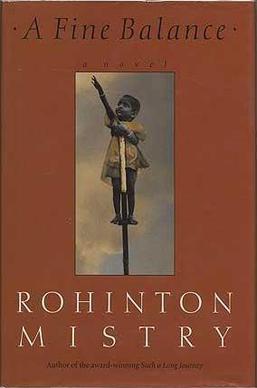
A Fine Balance
Rohinton Mistry

number of voters: 7
percentage of voters who finished the book: 100
highest rating: 9
lowest rating: 6.5
average rating: 7.7

percentage of readers who were disappointed in some way or another with the ending: 100
NOTE: All quotes in this recap are from the book.

*****
“Birth and death—what could be more monstrous than that? We like to deceive ourselves and call it wondrous and beautiful and majestic, but it’s freakish, let’s face it.”

Part history. Part fiction. All epic.

Set in India during “The Emergency,” A Fine Balance follows four characters on a roller coaster existence of day-to-day survival. It is dark and funny and moving and maddening. “After all, our lives are but a sequence of accidents—a clanking chain of chance events. A string of choices, casual or deliberate, which add up to that one big calamity we call life.”

Rohinton Mistry pieces together a quilt of characters (both major and minor) and events (both national and miniscule) that is both beautifully rich and tragically threadbare. The end result is that “the whole quilt is much more important than any single square.”

The main characters are intriguing, if not always likable, each one struggling to survive. “You have to maintain a fine balance between hope and despair. In the end it’s all a question of balance.” Although it could be argued that in the end the author makes his opinion known as to which wins out.

A Fine Balance is not for everyone. It is long, slow in places, at times frustrating, and often infuriating. But for the patient reader, this epic tale of a country gone mad is a truly rewarding experience. “Flirting with madness was one thing; when madness started flirting back, it was time to call the whole thing off.”

Love in the Time of Cholera

[August 2009]

**********
Love in the Time of Cholera
Gabriel Garcia Marquez

number of voters: 2
percentage of voters who finished the book: 100
highest rating: 5
lowest rating: 5
average rating: 5

question of the night: Can really good writing redeem a really long story with really unlikable characters?

**********

She pulls the faded book from the shelf, dusting its cover with the palm of her frail hand. The pages are worn and yellowed, corners threading from years of folding and unfolding where the reader had marked his place. As she opens the cover, a musty smell fills her nostrils, and she breathes deep its familiar scent.

This is the book. This is the book that her lover read and reread from the time she first knew him until the day it fell from his hands in his final repose.

She’d never dared to open it since that day. How it came to be on this shelf, she would never learn, but there it was, and without pausing to contemplate the repercussions of the ensuing memories, she had removed it from its own repose.

It is just a book, she tells herself. Just a story. There is nothing to fear from a story, a jumble of words arranged in a particular order. But her hands tremble nonetheless. And her fingers fumble with the frontispiece as she turns to chapter one.

...

As if from a dream she awakens to the final sentence, five words loaded with a subtext that sends her heart plummeting. This is the book. This is the book that her lover, to whom she had abandoned herself and her purity for innumerable years, had so desperately adored. Her stomach roiled.

Who was this man who had loved a book with such unlikable—nay, appalling—characters and such a tedious plot. Had he seen himself in this same light? Had he thought of her in this way?

The writing was beautiful; perhaps he merely enjoyed the language the author employed. Perhaps he felt a particular sympathy for these drifting souls. Or maybe, through some literary trick of the mind, he was drawn to the disease of the title, somehow knowing that he too would die by its clawed grasp.

This was the book he had loved as much as, if not more than, he had loved her. A better woman might return it to its resting place on the shelf for others to find, read, ponder.

She throws it in the fire and watches it burn.