The Memory Keeper's Daughter

[July 2008]

**********
The Memory Keeper’s Daughter
Kim Edwards

number of voters: 5
percentage of voters who finished the book: 80
highest rating: 8.5
lowest rating: 3
average rating: 5.6

number of books, including this one, for which Angie has written a recap without having read the book: 1

**********

No one knows for sure who recommended The Memory Keeper’s Daughter. If only we knew, then we would have someone either to thank or to blame.

Some enjoyed the writing style, others despised it. Some felt no attachment to the characters, others connected with them. Some thought it was an easy read, others just couldn’t get into it.

The one point on which we could almost agree was that the storyline was interesting—albeit depressing.

The story centers on an over-achieving doctor and his wife and their set of twins. The son arrives first, a healthy strapping boy. The daughter comes next, but is seen by her father as imperfect because of her Downs syndrome. He secretly sends the daughter to an institution and tells his wife she arrived stillborn. From here the story unwinds in a slow burn, as lies and deception tear the once-happy couple apart and a new life comes to an unexpected mother.

As a group, we enjoyed discussing the realism of the book’s plot as well as its relationship to other books we’ve read recently.

Maybe the best summary of our opinion on this book is this: When I asked if I should take the time to read it, no one really said yes.

The Curious Incident of the Dog in the Night-time

[June 2008]

**********
The Curious Incident of the Dog in the Night-time
Mark Haddon

number of voters: 5
percentage of voters who finished the book: 100
highest rating: 9
lowest rating: 8.5
average rating: 8.8—our highest rated book so far

percentage of readers who understood all of the math concepts presented in this book: 0

**********

Take one novel (N), divide it by one part mystery (m) plus one part humor (h), add any autism spectrum disorder (A), multiply it all by some fantastic writing (lit), and you’ve got one great book.

({N / (m + h)} + A) x lit = awesome

You don’t need to understand one part of this (or any other) math equation to appreciate—and even love—The Curious Incident of the Dog in the Night-time. This is a fascinating, entertaining, funny, sad, well-written, easy-to-read, and possibly downright brilliant book, and it’s all told from the perspective of a fifteen-year-old boy who has Asperger’s syndrome and loves “maths.” He discovers that his neighbor’s dog has been murdered, setting into play a chain of impossible-to-foresee events.

What more do you need to know to convince you to read this book? Simply refer back to the above equation and solve for awesome.

Eli

[May 2008]

**********
Eli
Bill Myer

number of voters: 4
percentage of voters who finished the book: 100
highest rating: 7
lowest rating: 6
average rating: 6.375

percentage of readers who hope they are sheep (as opposed to goats): 100

**********

The Parable of the Somewhat Dissatisfied Reader

There once was a woman who read a book. It was an ordinary book with an extraordinary concept: What if Christ hadn’t come to Israel 2000 years ago but to America, today? The woman was intrigued.

She read the book quickly; it was a fairly easy read. She thought it was somewhat interesting and that it provided a few thought-provoking moments. But this book didn’t move her the way she expected it might. For such a fascinating concept, the book left her rather uninspired. Perhaps it was the writing (a bit lackluster), or maybe the characters (sort of one-note), or the parallel universe plot (a tad sci-fi).

On the other hand, the book had held her interest. There are many many (and might we add MANY) worse books out there. And it made her wonder... How would she respond if Christ were to appear today?

As the woman finished the book, she pondered her options: pan it? praise it? pass it on?

Well, dear disciples of literature, what would you do?

I Know This Much Is True

[April 2008]

**********
I Know This Much Is True
Wally Lamb

number of voters: 4
percentage of voters who finished the book: 75
highest rating: 8.5
lowest rating: 5
average rating: 6.625

percentage of readers who wish their life was as cheery as Dominick Birdsey’s: 0
**********

If our lives were as rotten as Dominick Birdsey’s, maybe we’d be grumpy, pessimistic cranks too. And maybe we’d swear just as much.

And maybe Wally Lamb intended I Know This Much to Be True to be a long, foreboding journey.

But that doesn’t mean that we have read it. Or like it.

We were interested in the story; it was mysterious, intricate, believable (mostly). The dynamic between the brothers was riveting. The familial history was fascinating.

But just once, maybe, we would have liked Dominick to take a “glass half full” approach to life. Just once we would have liked the author to have offered a glimmer of hope.

The few who read to the last page were rewarded with an unexpected shining moment. But it was a long time coming.

The Time Traveler’s Wife

[March 2008]

**********
The Time Traveler’s Wife
Audrey Niffenegger

number of voters: 5
percentage of voters who finished the book: 100
highest rating: 7
lowest rating: 6
average rating: 6.45

number of readers who, in the middle of book group, time traveled to their high school reunion and visited with their high school selves: 1

**********

Monday night.

7:08 pm.
Everyone is glad for a chance to discuss this book. It is nothing if not memorable.

7:18 pm.
We don’t really like the book. It’s hard to follow. The characters are unlikable. There are quite a few raw, ugly sex scenes.

7:42 pm.
The ending confuses us, disappoints us, intrigues us, surprises us, pleases us—sometimes all of these together. There is much discussion about what actually takes place.

7:23 pm.
We think the time traveler himself is a little creepy. We try to like him, but we don’t always succeed. He both pitiable and despicable. His wife is sometimes pathetic. We like her mostly, but not always. They do not leave us ambivalent.

7:30 pm.
We heartily agree that Gomez is the worst character in the book, on many levels.

7:51
We wouldn’t recommend The Time Traveler’s Wife to just anyone, but we would recommend it, with caution, to some. It is a book that hits you like an exposed nerve, shocking and sometimes uncomfortable, but it is an experience you will always remember.

7:36 pm.
We do kind of like this book. It scores major points for originality. It’s incredibly romantic and dreamy. We are amazed that this is the author’s first novel.

7:00 pm.
Christina, Megan, and Stephanie arrive at Angie’s house, each with a copy of this month’s book, The Time Traveler’s Wife by Audrey Niffenegger.

Rocket Boys

[February 2008]

**********
Rocket Boys
Homer H. Hickam

number of voters: 4
percentage of voters who finished the book: 25
highest rating: 8
lowest rating: 7
average rating: 7.4375

percentage of readers who, upon reading this book, became nostalgic about a time before they were born: 100

**********

There is a place you have never been, never will go. This place doesn’t exist anymore, hasn’t existed since, perhaps, before you were born. Some of the people who lived there, then, have died; eventually, the rest of them will too. But this place, though gone, will not be forgotten.

Herein lies the wonder of a book: a time and place immortalized by the written word before it is lost forever in the memories of those who were there but are now gone themselves.

And so, we enjoyed Rocket Boys for its glimpse into history: Coalwood, West Virginia, circa 1950, a small mining town seemingly far-removed from the space race between the U.S. and the Russians, the story of one boy, Sonny Hickam, born a coal miner’s son, who raised himself on rockets and grew up to be an aerospace engineer.

Books like Rocket Boys are the reason we read. They provide windows through which we can peer into the lives and times we might otherwise never have known.

Anne of Green Gables

[January 2008]

**********
Anne of Green Gables
L.M. Montgomery

number of voters: 5
percentage of voters who finished the book: 100
highest rating: 9.5
lowest rating: 7.5
average rating: 8.25

percentage of readers who used the word “delightful” in their description of this book: 40


**********

It would be most efficient to simply say that we at the First Monday Reading Group loved this book. But then, where is the poetry in that? For in describing a thing we can merely list its attributes or we can describe the beauty and emotion that the thing inspires.

And so, we could say that Anne of Green Gables is a nice story about an orphan girl who finds a home. It is well-written and will appeal to those at any age in any part of the world. We could say that it is timeless and universal, or that it is a fine piece of literature.
Any of this would do.

And yet, to capture the essence of this book, we should be more inclined to say that it is a divine tale, charming, a breath of fresh literary air. The characters are simple yet well-drawn, simultaneously ideal and flawed. The author’s descriptions are like bursts of color on a gray pallet, shimmering reflections of a day long gone, brimming with purity and romance.

Yes, this is what we should say. After all, if it is efficiency for which you long, Anne of Green Gables may not be the book for you.

Left to Tell

[December 2007]

**********
Left to Tell
Immaculee Ilibagiza

number of voters: 6
percentage of voters who finished the book: 100%
highest rating: 9
lowest rating: 6.25
average rating: 7.42

percentage of readers who said Left to Tell was one of the best books they’ve ever read: 50

First Monday Reading Group liked this book better than Mere Christianity, by C.S. Lewis (7.4) but not quite as much as Watership Down, by Richard Adams (7.45)


***

A straightforward story deserves a straightforward review. 

As a group, we were split down the middle about Left to Tell. While half of us thought it was one of the best books we’d ever read, the other half was left wanting more.

But let’s start with what we all agreed on. We all agreed that ImmaculĂ©e Ilibagiza has an incredible story to tell. Her experiences were devastating. Her survival is astonishing. Her faith is inspiring. Her ability to forgive is nearly incomprehensible. She tells her story in a simple, “here’s what happened” way.

And that, maybe, is the main distinction for those of us who didn’t love the book. It was an amazing story, but it could have been told in a more impressive way. Not much of a complaint, perhaps, but we are a literary group, after all.

Above all, however, Left to Tell raised our awareness about an African culture that is more like our own than we realized (modern housing, clothing, etc.) and yet at the same time more unlike our own than we realized (brazenly hateful and violent). This book taught us a history lesson about a recent genocide that, even a mere 13 years ago, many of us are too young to remember. And lastly, this book inspired us through one woman who, facing unimaginable horrors, trusted God for her life and was left to tell.

Cane River

[November 2007]

**********
Cane RiverLalita Tademy

number of voters: 6
percentage of voters who finished the book: 100%
highest rating: 8
lowest rating: 6
average rating: 6.67

percentage of readers who are women: 100
percentage of readers who are white: 100
percentage of readers who have any firsthand knowledge or understanding of slavery: 0
percentage of readers who, through reading this book, learned something knew about the history of slavery in America: 100

I am compelled to write.

The forewomen of First Monday Reading Group are standing behind me, reading over my shoulder, willing my fingers to type.

It isn’t that Cane River is the best book we’ve ever read. The writing is scattered, the dates muddled, the facts uneven. But something in the story of these women pulled us in, pushed us forward.

That’s how it is with Cane River, Lalita Tademy’s very personal tale of her ancestor’s generational passage from slave to free.

It’s a novel—not quite historical fiction, not quite personal memoir—but the line between fact and fiction is blurred as much as the line between blacks and whites. It’s a narrative about slavery, but it is unlike any story of slavery we’ve ever read.  It’s a picture of the strength of women who labored under the burdens of injustice yet who could still hold their heads high.

The story is in turns fascinating, frustrating, maddening, moving. It is not quite the portrait of good and evil to which we are accustomed; one might, in fleeting moments, sympathize with a plantation owner who is facing bankruptcy, or perhaps, surprisingly, understand the unenviable position of a white man who loves a black woman. And yet, no amount of sympathy outweighs the simple, incomprehensible fact that human beings—mothers, daughters, fathers, sons, brothers, sisters, babies—were bought and sold, as though they were nothing more than cattle.

This is the history of America. It may be flawed, but it is what our nation is made of. Cane River offers an honest glimpse of one important thread of this American tapestry.

The Kite Runner

[October 2007]
 
**********
The Kite Runner
Khaled Hosseini

number of voters: 6
percentage of voters who finished the book: 100%
highest rating: 8.75
lowest rating: 7
average rating: 7.92
percentage of readers who speak farsi: 0

number of book recappers who spent entirely too much time googling farsi words for this recap: 1


The First Monday Reading Group became what it is today in the year 2003, with a cool autumn read of the well-received The Secret Life of Bees.

Four years and forty-some books later, we start another year, another cool fall with another well-received ketaab (that is, book): Khaled Hosseini’s The Kite Runner.

Hosseini’s vivid descriptions of his homeland of Afghanistan seep from the pages like dripping honey. One can almost see the kites dancing in the sky, smell the dusty air, and taste the ripe, juicy pomegranates.

The story is richly told with both broad strokes and tiny detail. Its well-drawn characters are both amiable and despicable, and sometimes at the same vaqt (time). The author weaves many colorful threads into a beautiful, devastating tapestry, and just as we begin to expect an ending in which all these threads are tied up neatly, the conclusion does nearly the ruberu (opposite), leaving a frayed and raw edge.

It is sometimes surprising to love a book that is so difficult to read, a book that is agonizing and heartbreaking but still manages to be lovely, a book that is so far removed from the life that we know. Truly, good literature can be measured by how well it conveys a time and place completely unknown to us and by how subtly it teaches us so much about another culture and its history.

And that brings us to this: In the novel, it is Rahim Kahn who says that there is a chance to be good again; Khaled Hosseini has found a way for literature to be good again as well.

Sammy’s Hill

[July 2007]

**********
Sammy’s Hill
Kristin Gore

number of voters: 6
percentage of voters who finished the book: 100%
highest rating: 9
lowest rating: 7.5
average rating: 8.167

percentage of readers who have accidentally emailed an embarrassing email to the wrong address: undisclosed

***

From : angie
To : Sammy’s Hill
Cc: ANGIE’s LIST of high-ranking book club officials
Subject : last night

Hey hot stuff! I know we were together just moments ago, but I couldn’t wait another moment to tell you how great you were last night (and every night before that… and some mornings too… and that one time in the restaurant). It makes me blush just thinking of some of the crazy situations you got me into! You were such a good read that I even took you into the bathroom. Sure, there were some lulls here and there, but for the most part you held my attention and even made me laugh out loud. Your stories are so well-written. I loved all the insider tidbits about working on Capitol Hill… doesn’t it make you feel so grown up and so childish at the same time? I can totally relate to that! And I had so much fun with you… especially when you stayed up late working on briefs… or boxers… or… But there I go blushing again! Looking forward to seeing you (or any sequels) again.
Your secret email lover

P.S. Wouldn’t it just be awful if I accidentally mailed this to like the President or something?!!

Confessions of a Shopaholic

[June 2007]

**********
Confessions of a Shopaholic
Sophie Kinsella

number of voters: 4
percentage of voters who finished the book: 100%
highest rating: 7.5
lowest rating: 6
average rating: 6.75


Dear Ms. Kinsella,

Thank you for your novel Confessions of a Shopaholic. We are greatly relieved to inform you that we found it to be an easy, light, summer read.

However, due to the discerning tastes of our book club, we are unable at this time to give you any rating greater than a 7.5. Though we enjoyed the book as “chick lit,” we could not grant it status as “literature.” And even in the chick lit genre, we had to admit that it wasn’t the best we had read.

On a positive note, there were no ratings lower than a 6, which is something to be proud of indeed. Your keen British humor (or shall I say “humour”?) kept us chuckling throughout, and although some of us may have liked to see your main character transform herself, we settled for the realism that sometimes people don’t change but instead find circumstances under which they can survive.

In closing, we hope you will continue to pursue your passion for writing, but don’t expect this book club to hold its breath for your next offering.

Sincerely,
First Monday Reading Group

Running with Scissors

[May 2007]

**********
Running with Scissors
Augusten Burroughs

number of voters: 3
percentage of voters who finished the book: 100%
highest rating: 5
lowest rating: 3
average rating: 3.667

percentage of readers who question the authenticity of the stories in this book: 100

fun fact: Running with Scissors is our new lowest-rated book!


Let’s be honest and to the point: Running with Scissors, the “memoir” by Augusten Burroughs, is about as enjoyable as cutting off your toe with rusty hacksaw—that is to say, disgusting, cringe-inducing, and (under the majority of circumstances) pointless. Just as we would not recommend running with scissors, we do not recommend Running with Scissors.

The Ultimate Gift

[April 2007]

**********
The Ultimate Gift
Jim Stovall

number of voters: 7
percentage of voters who finished the book: 100%
highest rating: 9
lowest rating: 4
average rating: 5.64

number of readers who read the book aloud to their fifth-grade classroom: 1

We were in the fourth year of our book group, when into our midst walked this young book, all full of pomp and purpose. The Ultimate Gift was hoping to inherit our highly desired praise, but little did this swaggering book know that it was about to be put through a series of rigorous tests.

The Test of Story
Things started off well for “Gift.” The story sounded interesting, and we devoured it easily in its bite-size chunks. But it quickly became apparent that this story, while appealing, was nothing more than an undeveloped story idea. Unsatisfactory marks in this category.

The Test of Writing
Again, “Gift” failed to impress. The writing was pedantic and overly simplistic. While it worked well in a classroom setting (Good idea, Stephanie!), as a book for adults the author shoots for the moon and air balls. Lowest marks.

The Test of Content
This was “Gift’s” greatest success. The message was important and thought-provoking. Each chapter had enough content to be a book in and of itself. Highest marks.

The Test of Entertainment
“Gift” was so easy to read and contained such a simple message that we were easily entertained by it. Decent marks in this category.

The Test of Literature
Unfortunately for “Gift,” the lack of quality writing or story pacing ruins its chances to share a shelf with the classics of literature. It may perhaps be better suited to a doctor’s office waiting room.

Summary: A good idea poorly executed. While not a waste of time, The Ultimate Gift leaves a lot to be desired. In the end, does “Gift” receive the inheritance? You’ll have to read it for yourself to find out.

Till We Have Faces

[March 2007]

**********
Till We Have Faces
C.S. Lewis

number of voters: 5
percentage of voters who finished the book: 100%
highest rating: 9
lowest rating: 3
average rating: 5.6

percentage of readers who expected more from the likes of C.S. Lewis: 100

I am old now, after having attempted to read Till We Have Faces. I have nothing to fear from those who have read and enjoyed this book, so I will speak my mind. I will write what those who worship C.S. Lewis could never write.

Till We Have Faces is, according to its own subtitle, a myth retold; that is to say, the story is based on an ancient myth, that of Cupid and Psyche. Thus, Lewis, that old fox of an author who enjoyed the quality company of such writers as J.R.R. Tolkein, did not actually invent the plotline or the characters; he merely reimagined the setting.

Ordinarily, this would be a fine task to undertake and could result in an exquisite work of literature (After all, are not all stories, since the beginning of time, somehow the same story retold with new faces and places?). However, in Lewis’s somewhat clumsy hands, this retelling is more of a butchering, a dissection from which little can be learned and with few, if any, redeeming qualities (and, we might add, too many parentheticals, such as this one).

And so I will say what some may consider sacrilege: C.S. Lewis, in this case, illustrates his shortcomings as an author. Any compliments we might pay to the story must be given to the originators of the myth and not to Lewis himself; that is to say, those who enjoyed the book enjoyed it only on the basis of the original plotline—the myth—and not on Lewis’s retelling.

Lewis may have been brilliant in the field of apologetics, but he should have left the retelling of Greek myths to his more accomplished companions.

Pride and Prejudice

[February 2007]

**********
Pride and Prejudice
Jane Austen

number of voters: 3
percentage of voters who finished the book: 66.67%
highest rating: 9
lowest rating: 8.5
average rating: 8.667

number of book group members who claim Jane Austen modeled this book after said book group member’s own love life: 1

All agreed to meet at Barbadosfield, the home of Mr. and Mrs. Fuller of East Eugene. But when the time arrived, Mrs. Fuller hosted only Mrs. Gulka, Mrs. Poetzl, and Mrs. Renich. It was a lively crowd, however, as all the ladies were eager for a respite from the chaos of their own estates.

Mrs. Fuller was a most gracious hostess, and all were impressed with her skills in the kitchen. (Though they are quite capable of retaining a cook, the Fullers have a long history of priding themselves in their own baking abilities).

After tea and scones were served, the ladies all settled in for a discussion of the latest literary subjects of the day. It was universally acknowledged (even from those who knew not of what they were speaking) that Miss Austen’s book was both stimulating and entertaining. There was even some speculation that the plotline itself could have been garnered from their very own lives, and thus followed a lengthy tell-all of the ladies’ younger days, the days between their official comings out and their marriages. Vast are the similarities between twenty-first and nineteenth-century pursuits and conquers in love.

When it seemed that nearly all conversation on the subject had been exhausted (as indeed the ladies themselves had become), the carriages were called for. It took scarcely ten minutes for the footmen to arrive, and the ladies retired to their own estates.

It is said that, after returning home, each of the ladies retrieved a copy of the most modern of Greek myths (Till We Have Faces, by C.S. Lewis) and settled in for a long night of burning the library candle. Though this fact cannot be confirmed, one thing is certain: All are looking forward to the first Monday of April (April the Second) when they will have reconvene for another evening of respite from the chaos of their own elaborate estates.

Slapstick or Lonesome No More!

[January 2007]

************
Slapstick or Lonesome No More!
Kurt Vonnegut


The ratings and recap for this book are missing.

A Confederacy of Dunces

[December 2006]

**********
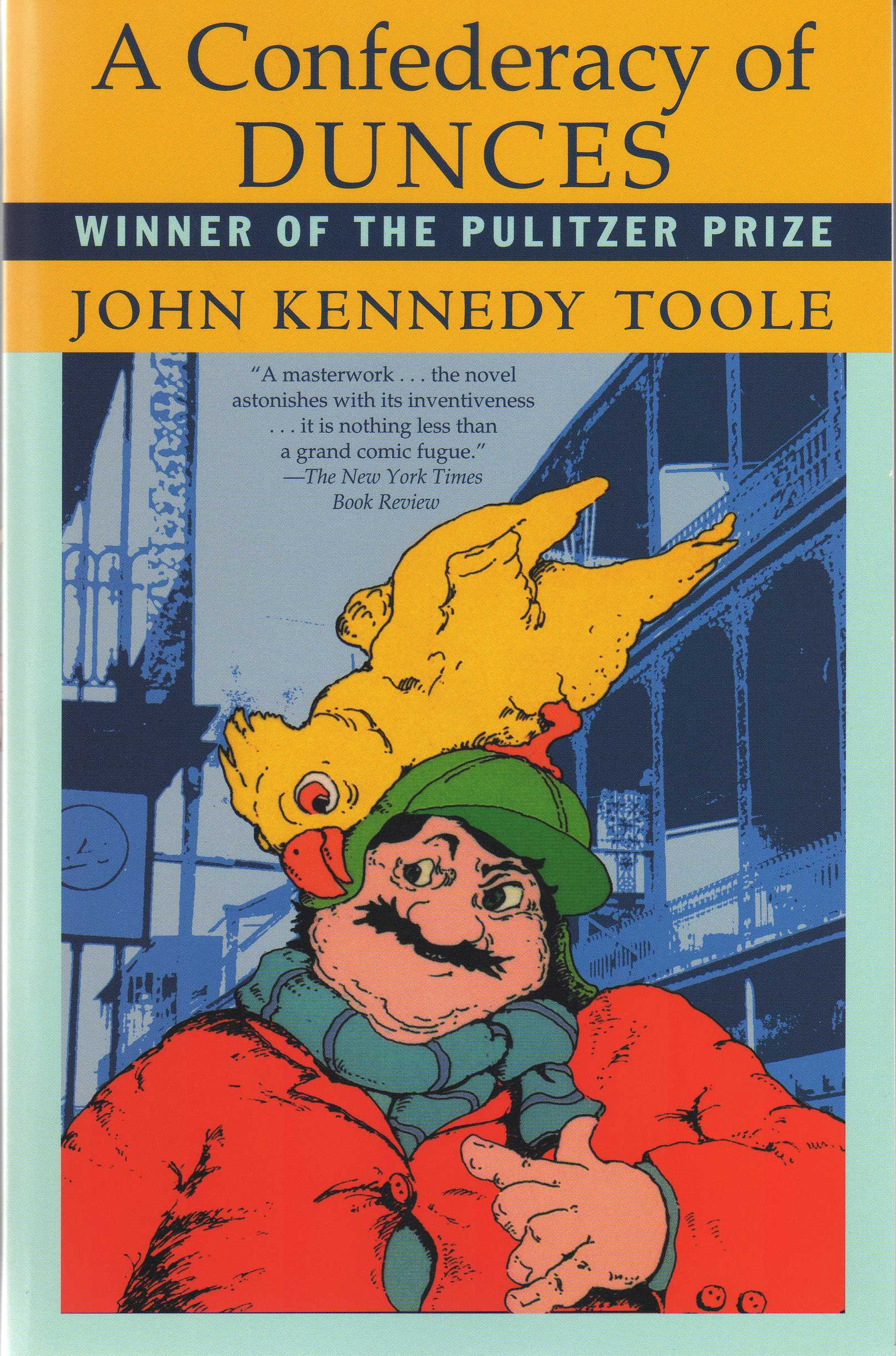
A Confederacy of Dunces
John Kennedy Toole

number of voters: 1
percentage of voters who finished the book: 100
highest rating: 4
lowest rating: 4
average rating: 4

number of book group members who finished this book: 1 of 10
percentage of book group members who would like their money back after buying this book: 100

What is there to say about this book?

Perhaps this: I’m so sorry.

Okay, okay… It wasn’t awful. At least not awful in an Our Lady of the Forest kind of way (according to Lindsay, who by the way wins the prize for sole finisher). And there were some funny parts.

But all in all, let’s not waste another moment of our lives on this book, okay? Not even on a rambling recap….

Life of Pi

[November 2006]

**********
Life of Pi
Yann Martel

number of voters: 5
percentage of voters who finished the book: 100
highest rating: 9
lowest rating: 4
average rating: 6.8

percentage of non finishers who got past Part One: 0
percentage of finishers who thought Part Two was gory: 100

A boy, a tiger, a hyena, a zebra, and an orangutan are stranded on the Pacific Ocean…. No, this isn’t the setup of a joke, it’s the setup of the novel Life of Pi by Yann Martel.

The boy is likable, a zookeeper’s son who pursues three religions at once, not because he is indecisive but because he is truly that dedicated to God.

The tiger is convincing, from the story’s first introduction of the species to the very real threat of sharing a small living environment with him.

The hyena is menacing, a gory reminder of the intricacies of the food chain.

The zebra is short-lived, nothing more than a meal for all involved.

The orangutan is endearing, a brave, motherly figure who reveals her strength and her defiance.

The story is both believable and unbelievable, a fascinating concept wrapped in a realistic package of gore and intensity, survival and boredom. It’s a work of fiction that tackles issues of faith and the value of life, and it does so in a way that questions the story’s own reality.

What if I told you that the whole tale was merely a figment of the boy’s imagination, a clever invention to mask the horror of what really took place? Would you believe the sensible, believable version, or would you give yourself over to faith and trust the beautiful and fanciful account of a boy, a tiger, and the Pacific Ocean?

The Color of Water

[October 2006]

**********
The Color of Water
James McBride

number of voters: 8
percentage of voters who finished the book: 75
highest rating: 9
lowest rating: 6.9
average rating: 7.675

percentage of readers of The Color of Water impressed with the accomplishments of the author and his family: 100
percentage of authors of The Color of Water impressed with the accomplishments of the author and his family: 100

What do a bunch of white women from twenty-first century suburbia know about growing up biracial in a 1960s inner city?

A whole lot more than we used to, thanks to James McBride’s The Color of Water.

It isn’t a page-turner, per se, but it is a fascinating portrait of a unique family. It offered insight into a culture with which we are highly unfamiliar.

McBride’s mother is an amazing, complicated woman who abandoned her Jewish heritage and immersed herself into the black culture of the times. Ruth Jordan was a victim of harsh circumstances, but through determination and perseverance—and her persistent resolve to teach her children “color blindness”—went on to accomplish great achievements (such as raising twelve, mixed-race children in the 60s—all of whom grew up to be successful in their own rights— and obtaining a college degree at age sixty-five).

A moving tribute to an amazing woman, The Color of Water is a window into another era, another culture, and indeed, another world.